
How to Tell If a Painting Was Actually Made by Hand

Somebody saw one of my paintings online recently and asked what software I made it in.
It is a stick with hair on it. Four hundred years of technology and nobody has improved on it.
I laughed, and then I thought about it for a week, because the question was completely reasonable.
On a screen, everything is the same thing. A painting, a print of a painting, and an image a machine generated in nine seconds all arrive as the same rectangle of light. There is no way to tell them apart there, and it is not the viewer's fault for asking.
So here is what I would tell anyone who is about to spend real money on a piece of art, or who has something on the wall already and has quietly wondered.
The one-minute test, in person
Look at it from the side. Stand close and turn your head so you are seeing the surface at a low angle, with the light raking across it. An original has topography. Ridges, valleys, places where the paint piled up and places where it was scraped back. A print is flat, and a print with printed texture is flat in a regular, repeating way. Your eye catches the regularity before your brain names it. You can see the brushstrokes and the way the artist worked painted into the canvas. Now some artists do work in hyperrealsim, so those will be smoother but you will still be able to tell that it was made by a human.
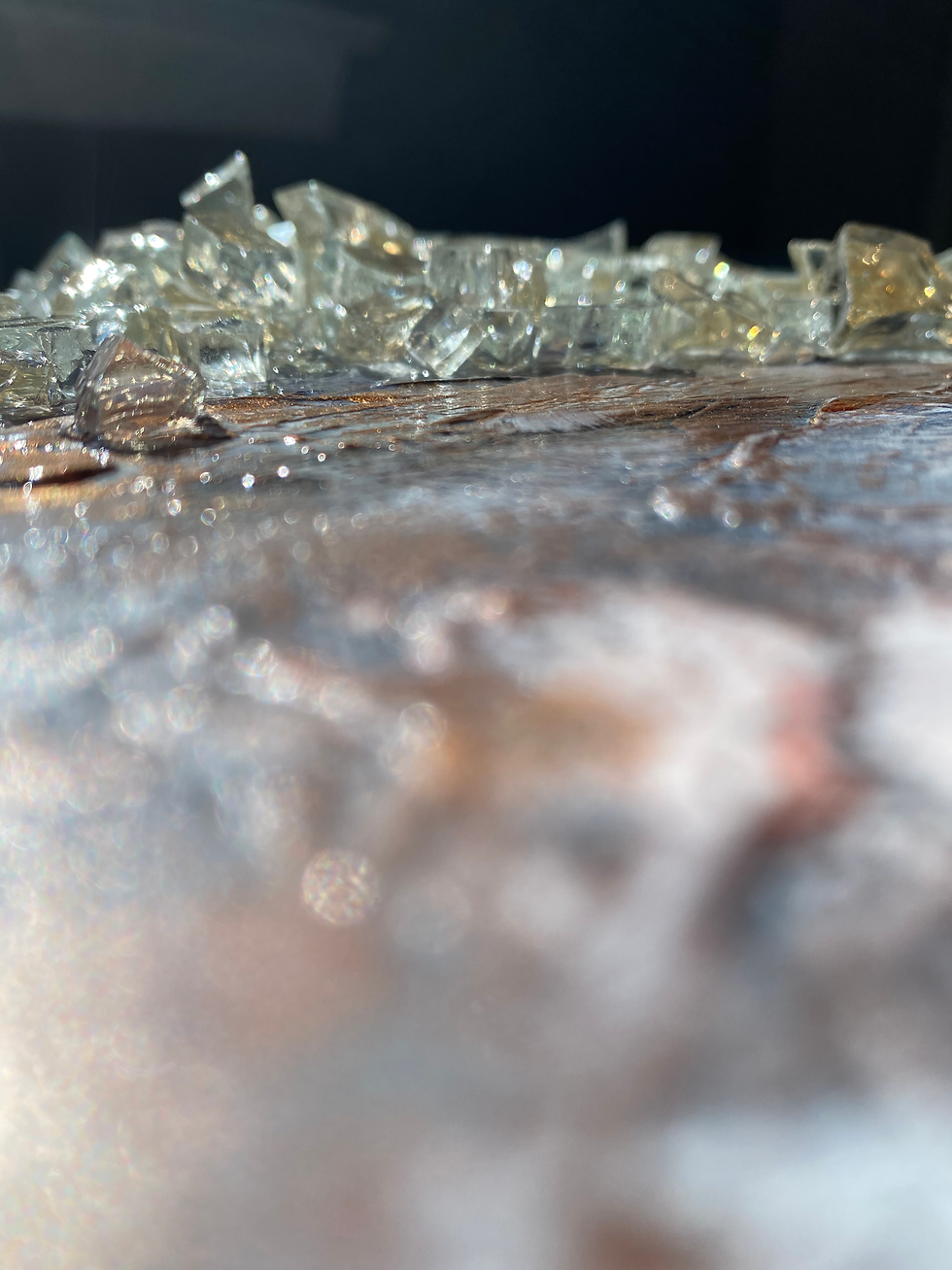
Then look at the edges. On a gallery wrapped canvas, hand painted work usually keeps going around the sides, because the person painting it was not thinking about where the front stopped. Reproductions tend to have edges that are suspiciously tidy, or that show the image stretched and continued digitally.
Then look at the back. Original work is not pristine. There is bleed, there is handling, there are stretcher bars that have been somewhere. As much as we try as Artists to be careful, random paint smears and fingerprints often get transferred on to the back or edges. Think of it as special personalization just for you. Reproductions often look newer on the back than they do on the front.
If you want to be certain, put a loupe on it, or just get your phone camera very close and zoom. Print reveals dots, rosettes, or a fine spray. Paint reveals layers sitting on top of each other, and edges where one colour stopped and another started.
The harder question, which is the new one
Telling an original from a print is an old problem with settled answers. Telling whether the image behind the work began in a machine as Ai has entered the world in full force is the new one, and it does not have a clean physical test, because a generated image can be printed on canvas and varnished, and it will pass the surface test badly but pass a photograph of the surface just fine.
What actually answers it is not the object. It is the record. Can a robot make art in 9 seconds that looks amazing? To a lot of people, yes. But I do not believe it will ever take the place of human creators. Knowing a person put their story, time, emotions, thoughs late hours and probably skipped some meals into a work of art is something no Ai created artwork can duplicate. There is no emotion behind it, the soul is not in the work and that is what makes it magical to me.
Ask whether there is process. Ask whether the artist can show you the piece at three stages and talk about what changed between them and why. Ask what the surface is made of and where the material came from. Ask what the work was before it was this, because almost every painting was something else first and the artist remembers it.
That is not a gotcha. Any working artist can answer all four of those in a sentence each, without preparing. A file cannot.
Why this matters more than it used to
For most of the history of this profession, nobody had to prove they made the thing. The making was assumed, and the conversation was about whether the work was any good.
That assumption is gone, and it is not coming back. Which means provenance, the boring paperwork word, quietly became one of the most interesting things about original work. When something can be generated instantly and infinitely, the value of a thing that took months and exists once goes up, not down.
I am not worried about it. I am aware that I now have two jobs where I used to have one. The first is making the work. The second is being able to show, on request, that I did. Filming my process has always been a part of the work since social media metrics and reach became the new way for an artist to expose their work to new eyes. It is just needed more now than ever.
My work is developed by hand across months, in oil, acrylic, resin, marble dust, real earth, gold and glass, amoungst other mediums depending on what the piece needs. Each one exists once. If you are ever looking at something of mine and you want to see how it was built, ask me. I will show you the ugly middle stage, which is my favourite part anyway but I warn you, that is when the art studio looks like someone may be living in there and the pile of old coffee cups betrays my long hours at the easel.
Original work and commissions are available by inquiry. I appreciate you stopping by. I like to say, come for the art and stay for the conversation. It is fun to meet new people who enjoy art as much as I do so feel free to reach out if you have any questions.
Warmly,
Dani

