How to Hang and Light Large Original Art

Updated: Aug 6
Hang a large original with its center about 57 to 60 inches from the floor, light it from a gentle angle with warm, low UV light, and leave enough quiet wall around it to breathe. Those three things, height, light, and room, do almost all of the work. Get them right and a big piece settles into a room like it was always meant to be there.
I hear this question a lot after a painting ships, usually from a collector standing in front of a beautiful blank wall wondering if they are about to get it wrong. You are not. It is far more forgiving than it looks, and once you have hung one large piece well, you will never second guess the next one. Let me walk you through it the way I would if we were standing in the room together.
How high should you hang a large painting?
Start with the center of the piece, not the top. You want the visual center to land right around 57 to 60 inches from the floor, which is average gallery eye level and the height most rooms feel calm at.
For a very tall piece, the math changes a little, so here is the simple version:
Measure the height of the painting and find its center point.
Decide your center line on the wall, somewhere around 58 inches is a safe, gracious default.
Hang so the painting's center sits on that line, then adjust up or down a touch for the way people actually use the room.
The one honest exception is a space where everyone is seated, like a dining room or a low lounge. There you can drop the whole thing a few inches so the work meets a seated eye. A large piece wants to feel like it is greeting you, not looking over your head.
What is the right lighting for original art?
Warm, even, and angled. The loveliest light for original work is soft, comes in from roughly a 30 degree angle above the piece, and washes the whole surface evenly rather than spotlighting one hot patch in the middle.
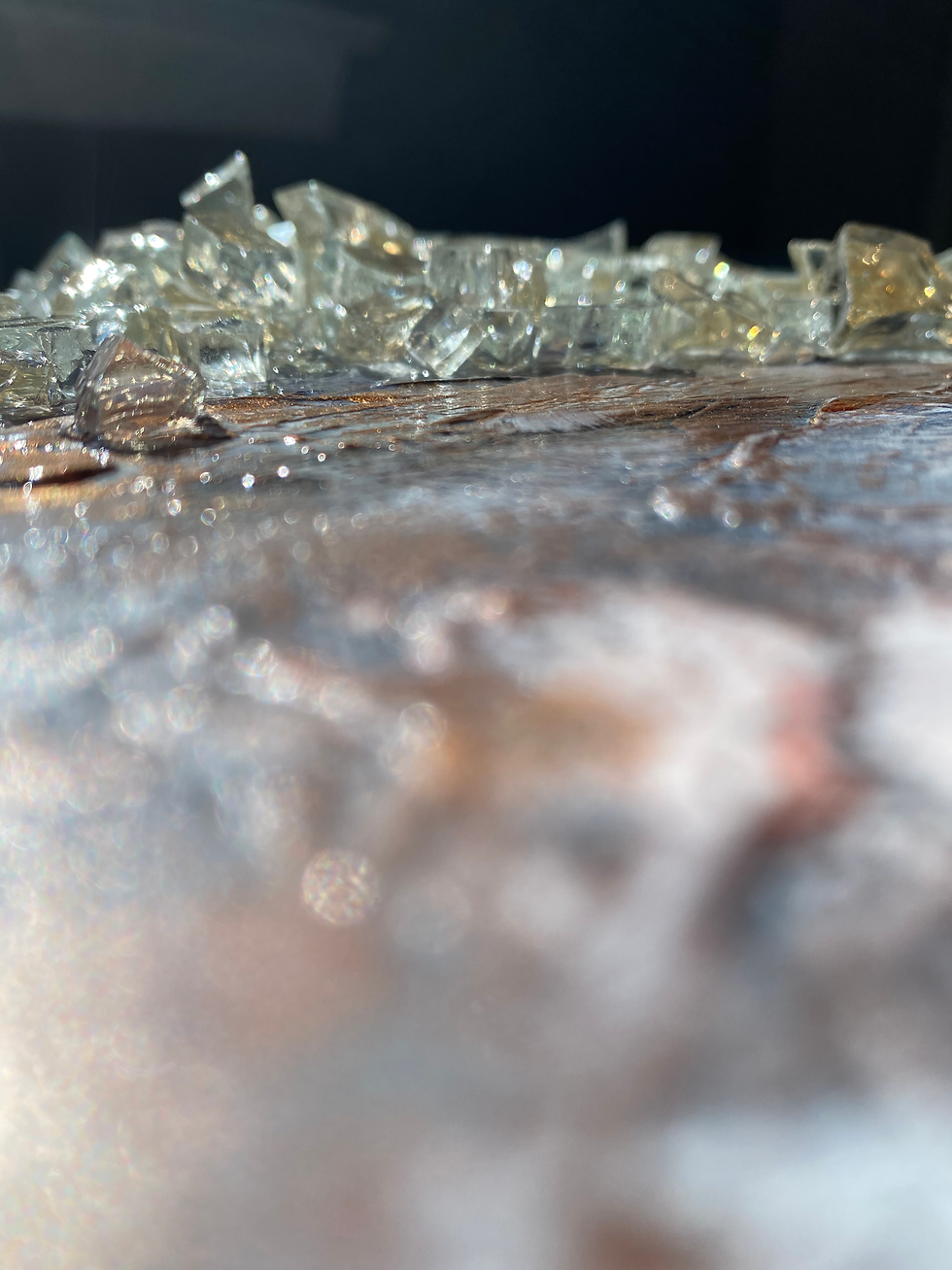
Angle matters most with my Material works, the pieces built from resin, mineral, glass, gold leaf, and real Sedona earth. Those surfaces have real depth and texture, and a raking light from the side wakes all of that up, so the gold catches and the earth reads like earth. A flat straight-on light can wash that away. If you are working with a piece from the Sedona Earth collection, try the light a little more from the side than you think you need, then step back and watch the surface come alive.
For color temperature, aim for a warm white, somewhere in the 2700K to 3000K range. It flatters pigment and keeps whites from going clinical. Cool blue light makes original work look like a photograph of itself, and you did not acquire a photograph.
How do you light art without damaging it?
Keep it cool, keep it low UV, and keep it off the direct path of the sun. Heat and ultraviolet light are the two things that age a painting over years, so the goal is gentle illumination that flatters without cooking the surface.
A few easy habits protect a piece for decades. Use LED fixtures, which run cool and give off almost no UV, rather than old halogens that get genuinely hot. Position the light far enough back that you could hold your hand where the painting is and feel no warmth. And be a little careful with direct sun. A wall that gets a blast of afternoon light through a bare window will fade and stress almost anything over time, so a sheer, a shade, or simply choosing a calmer wall goes a long way. None of this asks you to live in a dim museum. It just asks for warm, cool-running light and a little distance from the harshest sun.
How much space does a large piece need to breathe?
More than most people give it, and that restraint is what makes a big work feel expensive. A large original wants a margin of quiet wall on every side so the eye can actually land on it, rather than fighting a gallery wall of smaller frames crowded up beside it.
The simplest guide I can give you: let the painting be the largest thing on its wall by a comfortable margin, and resist the urge to flank it with other art. Empty wall is not wasted wall. It is the pause that lets a piece speak. A big Narrative work, something figurative and story driven, needs that stillness around it so the story has somewhere to unfold. Give it room and it reads as a moment. Crowd it and it reads as decoration.
Where should a large original go in the room?
Put it where you naturally pause: the wall you face when you walk in, the one you see from your favorite chair, the surface a room already gathers around. Placement is really about the path your eye and your feet take through a space.
Over a sofa or console, the classic proportion is a piece that spans roughly two thirds to three quarters of the furniture below it, hung so the bottom edge floats about 6 to 10 inches above the back of the sofa. In an entry, a single large work does more than a cluster ever could, because it sets the tone before anyone says a word. Above a fireplace, do watch the heat and be sure the mantel throws it forward and away, and hang so the piece clears the mantel with a little breathing space. And if you are shaping a room around a wall that is genuinely oversized or unusual, that is often the moment collectors and I start talking about a commission, a piece made for the exact scale and light of the space it will live in.
Should you hang it yourself or bring in help?
For anything large, heavy, or textured, two sets of hands and proper hardware are worth every bit of the fuss. A big original deserves a secure cleat or heavy-duty hangers rated well above the actual weight, anchored into studs or with proper wall anchors, never a single nail and a hope.
If a piece is especially large or one of the heavier Material works, a professional art installer is a small, sensible luxury. They will get the height, the level, and the security right in one pass, and they protect both the wall and the work while they do it. When a piece leaves my studio, I am always glad to tell you what it weighs, how it is meant to hang, and how to care for the surface, so you are never guessing.
If you are settling a new piece into your home, or dreaming about a wall that is still empty, I would love to help you think it through. Contact the studio and tell me about the space, the light, and where your eye wants to land, and if you would like to see new work before it goes out into the world, the door to my Collector's Circle is always open.